
Follow the child’s lead. Find the earliest gap. Build securely from there.
Children struggle with new maths when something earlier was never secure. The Big Maths Baseline Assessment is a single lesson that follows each child back to their earliest Learning Gaps, so teaching starts from a solid foundation of number knowledge.
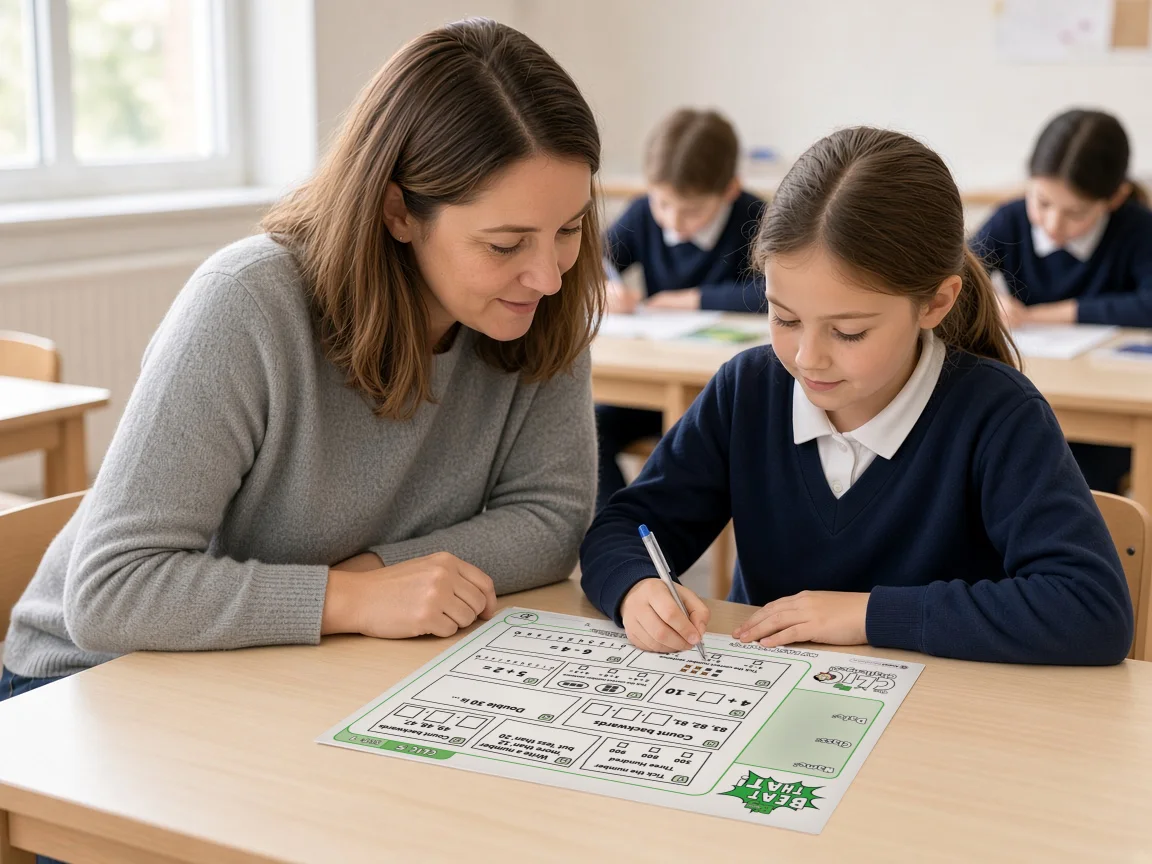
Why the starting point matters
It is vital to follow the child’s lead all the way down to their lowest-level Learning Gaps. Only then can you establish the solid foundation of number knowledge they need to make secure progress.
The real gap is often further back
A maths baseline assessment often surfaces gaps further down the CLIC levels than the year group would suggest. Teaching at age-related level, on top of those gaps, is why new learning does not stick.
This is not about lowering expectations
It is about finding the earliest missing knowledge that may be preventing later learning from becoming secure, then teaching from the right starting point.
Fewest gaps, quickest progress
Start a child in the right place and the teacher has the fewest immediate Learning Gaps to target. The child has the best chance of full marks, and of promotion in the shortest possible time.
How a Big Maths Baseline Assessment works
Six steps, completed on paper in a single lesson. It is introduced to the class as an exploration, not a test.
Confirm the Age Related Challenge
Start from where the class is expected to be this term.
Begin earlier than the year group
The exploration deliberately starts below age-related level, so children begin with success.
Use paper challenge sheets
Children try short CLIC challenge sheets. The tone stays light and positive.
Follow the evidence down
Move down or up as each child’s responses indicate, until the earliest Learning Gaps are revealed.
Find the secure level
Establish where the child is fully secure, then assign their starting challenge from there.
Teach the gaps
Enter the scores, review the Learning Gaps and schedule focused teaching.
See a maths baseline assessment worked through, step by step
The free Starter Pack follows one illustrative Year 4 pupil from CLIC 9 down to a secure foundation, and shows the key decision that sets their starting challenge.
The six steps in full
Exactly where to begin, when to move down or up, and how to decide a child’s starting challenge, with a one-page checklist.
Sample challenge sheets
Printable CLIC challenge sheets, CLIC 5 to CLIC 12, to try the method with one class.
An example intervention set
Repeat, Revisit, Real Life Maths and Mastery resources for one Learning Gap, with answers.
Get the Big Maths Baseline Starter Pack
38 pages. A worked example of the Big Maths Baseline process.
What it is: a sample of the method. What it isn’t: a complete baseline for your class or school. That needs the full paper process plus Big Maths Online, covering Years 1 to 6.
How results become next week’s teaching
A Big Maths Baseline Assessment is completed on paper. Scores are then entered into Big Maths Online, where the Learning Gaps tools help teachers identify priorities and plan the next teaching steps.
1. Set the level
Each child is set to their starting CLIC challenge.
2. Enter scores
Paper scores go into Big Maths Online. From there the system does the analysis.
3. See Learning Gaps
Step-level Learning Gaps appear for each child and class. Add the priority gaps and matched resources to the lesson plan.
Each gap comes with its own teaching resources. Repeat the skill first. Then Revisit, where pupils recognise “It’s Nothing New”. Real Life Maths presents the skill in worded questions, and Mastery follows. From then on, weekly Beat That! challenges and the weekly gap analysis keep the picture current.
Maths baseline assessment: your questions answered
Questions from maths leads and headteachers about the Big Maths Baseline Assessment.
Why run a maths baseline assessment at all?
Because the earliest missing knowledge is often what holds back later learning. A baseline finds each child’s secure foundation, so teaching starts in the right place.
How long does the Big Maths Baseline Assessment take?
For a standard class it is one single lesson.
When should we run it?
When your school joins Big Maths, and again at the start of each academic year or term. It is the recommended first step of implementation.
Is it the same as the Reception Baseline Assessment?
No. The Reception Baseline Assessment (RBA) is a statutory assessment taken in Reception. The Big Maths Baseline is a separate teaching tool, used across Years 1 to 6 to inform classroom teaching.
Is the free Starter Pack a full baseline for my class?
No. The Starter Pack is a sample that shows how the method works. A complete baseline for a class or school needs the full paper process plus Big Maths Online, covering Years 1 to 6.
What happens after the Baseline?
Weekly Beat That! challenges keep each child’s picture up to date, and the Learning Gaps tool shows teachers which steps to teach next. See Assessment and Tracking for the detail.
Start the year knowing where every child is
Book a relaxed tour of Big Maths, or a 30-minute chat about how a maths baseline assessment would work in your setting. No pressure, no hard sell.
See it with your own school in mind
Big Maths has been used in schools for over 15 years. We can show you how a Baseline would work for your classes.