What are fact families in primary maths?
Most children can tell you that 3 + 4 = 7.
But do they also know that 4 + 3 = 7?
And if they know those two facts, do they realise they also know that 7 – 3 = 4 and 7 – 4 = 3?
That is the power of Fact Families.
In primary maths, Fact Families (sometimes called number families) help children see that numbers are connected. They show that one known fact can reveal several more. In Big Maths, this matters because it reduces the amount children need to hold in their heads and helps maths feel simpler, clearer and far less overwhelming.
What is a Fact Family?
A Fact Family is a small group of related number sentences that all use the same three numbers.

Take the numbers 3, 4 and 7. They make this Fact Family:
3 + 4 = 7
4 + 3 = 7
7 – 3 = 4
7 – 4 = 3
One set of numbers. Four connected facts. That is a Fact Family.
Try it yourself: enter any three numbers
When both addends are the same, like 5 + 5 = 10. Switching the numbers gives the same fact.
So this family only has two members: 5 + 5 = 10 and 10 – 5 = 5.
Fact family triangles
A fact family triangle is the simplest way to show a Fact Family on paper. It has one number in each corner. The largest number sits at the top, and the two smaller numbers sit at the bottom. The two bottom numbers combine to make the top one, and the top number can be split back into either of the bottom ones.
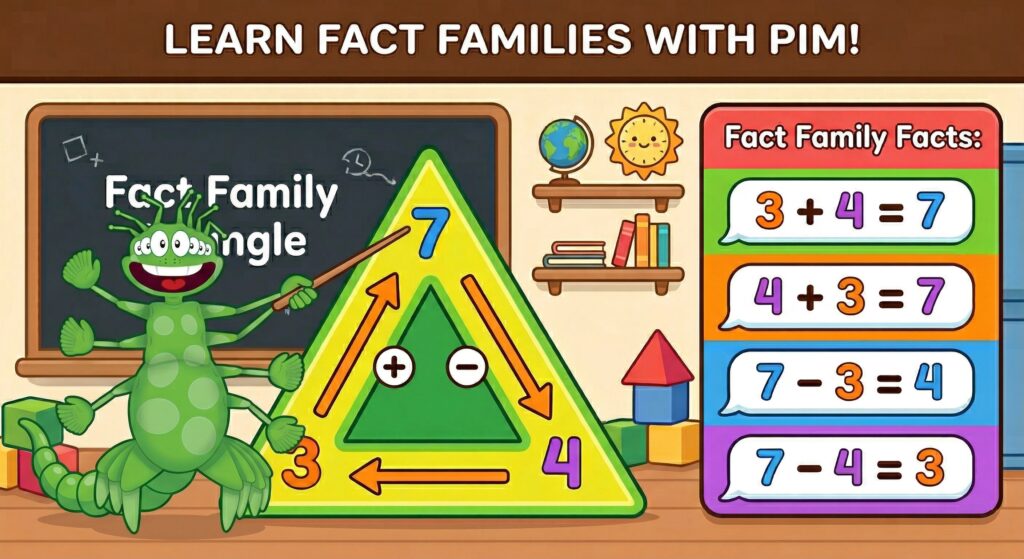
Pim’s triangle shows the family for 3, 4 and 7. The same triangle works for multiplication and division: put 21 at the top and 3 and 7 at the bottom, and it gives 3 × 7 = 21, 7 × 3 = 21, 21 ÷ 3 = 7 and 21 ÷ 7 = 3.
Read the triangle along the bottom for the two addition facts (or multiplication facts), and from the top down for the two subtraction facts (or division facts). The same three numbers, the same triangle, all four facts.
How to use a fact family triangle
Cover one corner with your thumb and ask the child to work out the hidden number from the other two. Cover the top and they add (or multiply). Cover a bottom corner and they subtract (or divide). Because the triangle never changes shape, children quickly see that subtraction is addition in reverse, and division is multiplication in reverse. That is the whole point of a Fact Family, made visible.
Triangles work well as a quick starter, in a home practice session, or as a blank sheet where children fill in the corners for the Learn Its they are working on. Keep to families built on facts the child already knows, so the triangle is revealing connections rather than introducing new facts.
Some schools call these number family triangles or number bond triangles. They are the same thing: three numbers, one triangle, four facts.
Fact family examples
Addition and subtraction
| Numbers | Addition facts | Subtraction facts |
|---|---|---|
| 2, 3, 5 | 2 + 3 = 5 and 3 + 2 = 5 | 5 – 2 = 3 and 5 – 3 = 2 |
| 4, 6, 10 | 4 + 6 = 10 and 6 + 4 = 10 | 10 – 4 = 6 and 10 – 6 = 4 |
| 7, 8, 15 | 7 + 8 = 15 and 8 + 7 = 15 | 15 – 7 = 8 and 15 – 8 = 7 |
Multiplication and division
| Numbers | Multiplication facts | Division facts |
|---|---|---|
| 2, 5, 10 | 2 × 5 = 10 and 5 × 2 = 10 | 10 ÷ 2 = 5 and 10 ÷ 5 = 2 |
| 3, 4, 12 | 3 × 4 = 12 and 4 × 3 = 12 | 12 ÷ 3 = 4 and 12 ÷ 4 = 3 |
| 6, 7, 42 | 6 × 7 = 42 and 7 × 6 = 42 | 42 ÷ 6 = 7 and 42 ÷ 7 = 6 |
Why Fact Families matter so much
Fact Families are important because they cut down what children need to memorise.
Without Fact Families, addition and subtraction facts, multiplication and division facts, can feel like separate pieces of learning. Children may think they have to learn them all individually. But when they understand the relationship between the numbers, they begin to see that one fact gives access to others.
Children’s working memory is limited. If they are using too much mental effort to work out basic number facts, there is less thinking space left for reasoning, problem solving and new learning. Fact Families help reduce that load by turning several separate facts into one connected idea.
How Big Maths makes this even easier
In Big Maths, children first learn Learn Its. There are 72 addition and multiplication number facts that need to be recalled instantly, without hesitation. Each term children learn new Learn Its, ensuring that they know all 72 facts (which means they know all their times tables) by the end of year 4 / primary 5 without any drama or stress.
So from learning one fact, for example:
3 + 4 = 7 (Learn It)
Then they use our Switchers approach. ‘Switchers’ is the Big Maths name for the simple observation that swapping the numbers in an addition sum gives the same answer. You might know this as the Commutative Law… but that term means nothing to a child. It is abstract, forgettable, and the moment you stop using it they forget it entirely. Switchers is a word that does what it says. Children understand it straight away and remember it because it connects to something real.
So now, with just one secure Learn It and its Switcher, the child already knows two facts.
3 + 4 = 7 (Learn It)
4 + 3 = 7 (Switcher)
Then comes the real magic.
The Fact Families concept reveals the inverse facts:
3 + 4 = 7 (Learn It)
4 + 3 = 7 (Switcher)
7 – 3 = 4 (Fact Family)
7 – 4 = 3 (Fact Family)
Suddenly, the child has not learned one isolated fact at all. They have unlocked a whole Fact Family from the same three numbers.
They start with one Learn It. Switchers gives them the second addition fact. Fact Families then reveals the two subtraction facts. So instead of learning four separate facts, they learn one relationship and see four connected truths. That is not a trick. It is strong mathematical understanding.
What about multiplication and division?
This is where Fact Families become even more powerful.
3 × 7 = 21 (Learn It)
7 × 3 = 21 (Switcher)
21 ÷ 3 = 7 (Fact Family)
21 ÷ 7 = 3 (Fact Family)
That is why this matters so much for fluency. Children do not need to experience multiplication and division as separate bits of learning. They can see that the numbers are connected, and that one known fact opens the door to several more.
Seeing the connections: Jigsaw Numbers
In Big Maths, Jigsaw Numbers is one of the strategies we use to make mathematical relationships easy to see. Jigsaw Numbers helps children to see that two parts fit together to make a whole, so by using their Learn Its, they can identify Jigsaw Numbers to 1,000 for any 3 digit number. Children can see, and trust the relationship before they are expected to explain it abstractly. That visual structure helps make Fact Families more concrete, especially when children are first learning to connect the numbers.
The strength of this approach is that the structure stays the same as numbers get bigger. Children are not constantly meeting new methods. They are applying the same understanding again and again.
A practical classroom example
Suppose a child knows this Learn It:
7 + 3 = 10
Switchers immediately gives them:
3 + 7 = 10
Fact Families then reveals:
10 – 7 = 3
10 – 3 = 7
Once children are secure with that, teachers can deepen understanding by varying the presentation:
10 = 7 + 3
10 = 3 + 7
7 = 10 – 3
3 = 10 – 7
Then by using missing number questions:
7 + ☐ = 10
☐ + 7 = 10
10 – 7 = ☐
10 – ☐ = 7
The numbers stay the same. The structure stays the same. The challenge shifts slightly. That is what real mathematical fluency looks like.
Questions about fact families
How many facts are in a fact family?
Usually four: two addition and two subtraction facts, or two multiplication and two division facts. A family built on a double, such as 6, 6 and 12, has two.
When do children learn fact families?
They start with small addition and subtraction families in the early primary years, and meet multiplication and division families as they learn their times tables.
What is a fact family triangle?
A triangle with one number in each corner. The largest number sits at the top, and children cover one corner and work out the hidden number from the other two. See the fact family triangles section above for diagrams and how to use them.
How can I practise fact families at home?
Pick three numbers that make a family and ask your child to say or write all four facts. Keep it short, and stick to families built on facts they already know well.
Are fact families the same as number bonds?
They are closely related. A number bond is a pair of numbers that make a total, such as 4 and 6 making 10. The fact family is the full set of addition and subtraction facts that come from that bond.
Is there a fact family triangle sheet I can print?
Yes. Print Pim’s triangle above and cover a corner, or draw three blank triangles on a sheet and let your child fill in the corners with the Learn Its they are working on. You will find more free downloads on our Resources page.
In summary…
Fact Families help children see that maths is connected. They show that a known fact is not a dead end. It is a doorway. Switchers gives them a second fact from Learn Its, Fact Families then reveal the inverse facts. 1 fact = 4 facts!
Practising fact families at home? The Big Maths Beat That! app for families includes Learn Its Practice, which shows the related facts from any fact your child knows.