
What to look for when choosing a primary maths programme
If you’re reviewing your maths provision, the problem isn’t a lack of options. It’s the opposite.
There are excellent planning schemes, fluency platforms, assessment tools, and intervention packages available, each solving a real need, but many schools end up with a patchwork: one resource for long-term planning, a separate app for fluency, a third-party tracker for assessment, and something else entirely for SEND pupils. Each part made sense when it was chosen. Together, they can create inconsistency, duplicated effort, and the quiet gaps that only surface later, when a child hits a sticking point that nobody can quite explain.

It’s worth acknowledging the landscape we’ve all been working within. The influence of ‘Teaching for Mastery’, NCETM, and Maths Hubs has been genuinely significant, not to mention the legacy of COVID 19. Many schools made changes during a period of real professional development and shared momentum. That isn’t something to dismiss. But the question now has shifted: does your current approach form a coherent, sustainable whole?
Ofsted’s mathematics subject report is clear that the strongest maths provision coordinates its elements (curriculum plans, teaching approaches, resources, assessment, reporting, and improvement mechanisms), so they work in harmony rather than as separate parts. When the system coheres, teachers teach with confidence, pupils meet the same ideas in the same ways across the school, and assessment actually changes what happens next. When it doesn’t, even strong teaching teams can find themselves spending a lot of energy trying to join the dots (without a guarantee of success).
What follows isn’t a checklist any programme can simply claim to tick. It’s six diagnostic questions that help you see whether a programme will hold together in the real conditions of a school year: time pressure, staff changes, mixed attainment, and competing priorities.
The 6 questions every school should ask
1. Does it build fluency systematically — not just cover it?
Fluency isn’t just speed drills. It’s what allows children to think about the maths in front of them without working memory getting ‘swallowed’ by basic facts and methods. The EEF’s guidance on KS2 mathematics is explicit: pupils need to develop fluent recall of number facts as a foundation for everything else. Without it, harder maths becomes harder still.
The question is whether fluency is treated as a planned route… with clear sequencing, revisiting, and a measurable sense of what “secure” actually looks like, or whether it’s left to individual teachers to bolt on at the start of lessons.
Ask: is there a dedicated, daily routine for fluency? Does the programme tell teachers what to make fluent and when it’s secured, or does it just tell them to practise?
A quick reality check: if you removed your separate fluency tool (if you have one) tomorrow, would your maths programme still give you a clear, manageable path to secure number fact recall?
2. Does assessment drive next week’s teaching, or just this term’s report?
Most schools assess. The difference is what happens because of the assessment.
The EEF frames effective formative assessment as something that provides up-to-date, specific information about what pupils do and don’t know… information that should change the planning of future lessons and identify pupils who need targeted support. Not a six-week data drop. Not a termly judgement. Something that can steer next week’s lessons based on Friday’s assessment.
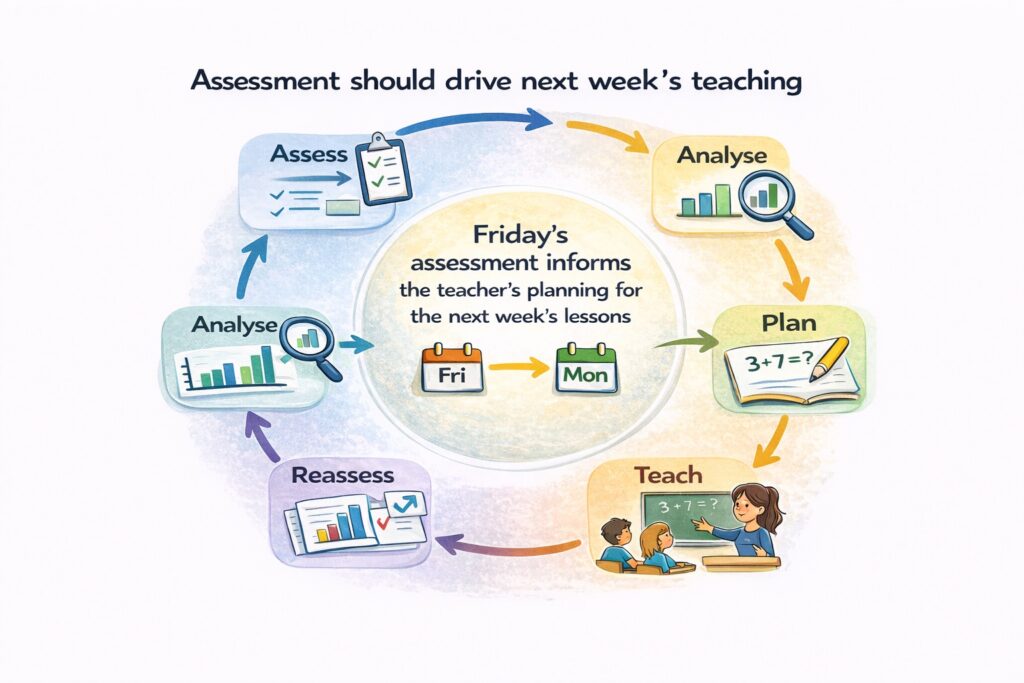
Ask: how short is the feedback loop? Does the assessment point to a specific concept or relationship that’s insecure, not just a score? Also ask if it is manageable for teachers, rather than generating onerous marking workload?
You’re looking for, and deserve an assessment that behaves like a steering wheel, not a rear-view mirror.
3. Is progression based on readiness, or just age?
Most schemes are organised by year group. That’s understandable, it fits timetables, government tick box exercises, and whole-class teaching. The risk is when year-by-year sequencing becomes the only progression model.
In that world, some pupils are pushed ahead before they’re secure and cope by memorising procedures they don’t understand. Others wait, stalled on a concept that needs a smaller step or a different representation. Both patterns are common, and both are avoidable. It’s basically a system of buses, where if you are on board at the right time and stay on board, you stand a chance of reaching the target. If you miss the bus or get off too early… tough.
Ofsted’s emphasis on “small steps” in curriculum sequencing is essentially an argument for progression that is conceptually coherent, not simply paced by the calendar. The best programmes can show precisely where a pupil is in the learning sequence, regardless of year group, and give teachers the specific next step without requiring them to design it from scratch.
Ask: can your current approach tell you exactly what to teach a child who is stuck, does it help you to identify their lowest level learning gap, without inventing extra resources? Can it show where every child is in the progression, not just whether they’re “on track” for the year?
4. Does it work for SEN/ASN pupils without needing a separate system?
A common and exhausting pattern: one approach for the main class, something different for an SEN/ASN group, and then a separate intervention package on top. The result is usually two unintended problems: pupils experience different language and structures, so learning doesn’t connect; and staff workload multiplies because they’re attempting to maintain parallel curricula.
The more sustainable model is a single framework that works for every learner… with small steps, consistent representations, and built-in scaffolds so that pupils stay within the same maths “learning journey” as their peers, just at the step that’s right for them.
Ask: do SEN/ASN pupils encounter the same models, vocabulary, and routines as their classmates? Does the programme offer smaller steps within the same progression, not an alternative route? Can TAs support learning using the same structure, without needing a separate resource bank?
Pupils who find maths hardest benefit most from predictability, structure, and cumulative success. Coherence matters most here.
5. Can every teacher (including NQTs and supply staff) deliver it consistently?
Whole-school consistency is often the hidden reason programmes eventually get replaced. Not because the scheme is poor, but because implementation fragments over time. Strong teachers adapt it. Newer teachers interpret it differently. Supply staff guess.
Ofsted notes that a carefully sequenced, centralised approach can particularly support schools with higher staff turnover or teachers with less subject knowledge. The aim isn’t to deskill teachers, it’s to make the baseline consistent so teachers can spend their energy on pupils’ thinking, misconceptions, and explanations rather than rebuilding the curriculum each week.
There is a harder version of this problem that rarely gets named. In many primary and SEN settings, the staff delivering maths are not specialist mathematicians — and that is not a criticism, it is simply the reality of how schools are staffed.
The difficulty comes when a programme claims to provide “small steps” but actually supplies higher-level waypoints, leaving the real work to be done by whoever is standing in the room: micro-diagnosing where a child is stuck, micro-sequencing the path forward, and designing the overlearning needed to make it stick. That is specialist work being transferred onto non-specialists without acknowledging it as such.
The mismatch sets staff and pupils up to fail. It also creates an accountability trap. Teachers are blamed for not delivering what the materials never fully specified in the first place.
A programme that genuinely reduces this burden does not just claim that its steps are small. It shows you the steps are small, in enough detail that the next move is unambiguous, regardless of who is standing at the front of the classroom.
Ask: could a confident NQT pick this up on a Monday morning and teach a strong lesson by Wednesday? Could a supply teacher follow it without having to guess the school’s way of doing things? Does it reduce the decision fatigue that comes from building lessons from scratch?
6. Does it integrate planning, resources, assessment, tracking, and most importantly… CELEBRATION!, or are those five separate subscriptions?
This is often the question that decides workload.
Many schools are paying for a scheme, a fluency app, an assessment tool, and an intervention programme, none of which talk to each other. The hidden cost isn’t just financial: it’s the cognitive load on staff, the inconsistency between classes, and the time spent moving data from one system to another rather than using it to teach.
A coherent programme doesn’t necessarily need to be one website, but it should behave like one system. Planning connected to progression. Assessment connected to what gets taught next. Resources matched to the specific step being taught, not a generic bank to search through. A system that recognises and prompts celebrations for each pupil’s achievements… every week!
Ask, bluntly: how many separate systems are staff navigating each week? What happens when you add a new teacher mid-year… do they have to learn four different tools to teach maths consistently?
The hidden problem: ‘small steps’ only help if they’re actually specified.
There’s a harder version of this problem that rarely gets addressed. In many primary and SEN/ASN settings, the staff delivering maths are not maths specialists. That’s not a criticism; it’s simply how schools are staffed.
The risk comes when a programme claims to provide “small steps” but actually supplies higher-level waypoints. In that moment, staff are left to do specialist work: diagnose the missing micro-skill, decide the teaching sequence, and create enough varied practice for pupils who need longer to embed concepts.
When that micro-sequence isn’t made explicit, the system quietly pushes people towards pace over security: move on, hope it sticks later, and carry the gap forward. The accountability then lands on the classroom adults, even though the tools required to close that gap were never fully provided. The pupils are the ones who pay the price.
What good looks like
When the answers to these six questions point in the same direction, the atmosphere in a maths classroom tends to change. Not because the programme is simplistic, but because it’s consistent.
In practice, coherent maths provision tends to have these characteristics:
- A clear, small-step progression from EYFS to Year 6 / Primary 7, carefully sequenced so new learning genuinely builds on what came before, where misconceptions are anticipated, not discovered too late
- Fluency built through a dedicated weekly routine with a measurable outcome so it’s clear what pupils can recall reliably and what needs revisiting
- Short, frequent assessment that actually informs and changes teaching, not just a termly snapshot
- Progression based on readiness, so every child keeps moving forward from the point they’re secure, rather than being pushed ahead or held back by age or dates
- Shared language, representations, and routines across the school, so pupils experience maths as connected and cumulative journey, and staff can support one another naturally
- One system, not four tools stitched together
NCETM’s Teaching for Mastery framing rightly emphasises carefully selected representations, conceptual understanding, and procedural fluency developed together. The key point for programme selection is that mastery principles often depend on schools having a curriculum and system that make those principles practical and consistent day to day and that’s harder to achieve when the system is fragmented.
A note on confidence and anxiety
One factor often underweighted in programme evaluation is how the approach handles pupils who are anxious about maths or who have fallen behind. Incoherent systems tend to make maths feel like a constant reminder of gaps, so pupils are directed to see the distance between where they are and where they “should” be.
The most effective approaches build success into the small steps, so that confidence grows alongside competence. When every lesson is reachable, and every child is working at the step that’s genuinely right for them, the experience of maths changes, not just for the children who are struggling, but for the whole class. When a teacher recognises where each pupil is on their learning journey in real-time, they can better manage anxiety and apprehension.
Closing thought
If you’re currently reviewing your maths provision, it’s worth mapping your current approach against these questions honestly. You may find your existing programme covers most of them well. Or you may find some important gaps to explore, particularly around the assessment-to-action loop and the number of disconnected systems your staff are navigating each week.
Big Maths is designed as one coherent system, with progression, fluency, assessment, and resources, all in one platform. Our Progress Drives organise over 1,200 small steps from EYFS to Year 6 / Primary 7. The Big Maths Beat That! challenges assess progress weekly and feed directly into what gets taught next. Every step is linked to specific resources to reduce teacher workload and provide consistency. The same language, structure, and routines work across every year group, for NQTs and experienced teachers alike.
Book a free demo → to see how it works in practice, or download our free sample pack → to explore some of the resources before you decide.