
Maths and SEN/ASN: what actually helps in primary school?
In many primary schools, a familiar pattern plays out. A pupil with additional needs is identified as struggling in maths. With the best of intentions, they are moved out of the main lesson and into a separate intervention group. They work in a different room, with different resources, different vocabulary, and sometimes a different sequence of learning entirely.
When they return to the classroom, they are often more confused than when they left. They are navigating two competing systems of mathematical logic, two different sets of language, and two divergent sequences. This is not a failure of teacher intent. Schools work hard to help. But this approach can create a two-tier experience: one version of maths for most pupils, and a separate, fragmented version for those who need clarity and consistency the most.
The question worth asking is this. What if the problem is not the pupil, but the structure?
Whether we call it SEN, SEND, Additional Support Needs in Scotland, Additional Learning Needs in Wales, or use the terminology of individual education plans in international schools, the same pupils exist in every education system. The principles that help them are not country-specific. They are grounded in how children learn.
What the research says
Maths anxiety starts early and is a response to experience
Maths anxiety is not a secondary school issue. Research across multiple countries shows it can emerge in children as young as six. Studies consistently find a negative relationship between maths anxiety and mathematical performance, and importantly, research suggests that anxiety is often a consequence of repeated failure rather than an innate characteristic.
When a child encounters mathematical walls they cannot climb, the brain begins to associate maths with threat. Over time this interferes with the very cognitive processes needed for mathematical reasoning. To support pupils with additional needs, we need to design teaching so that success is the norm, not the exception.
This matters in every education system, not just those with formal SEN/ASN frameworks. The relationship between failure, anxiety, and avoidance plays out the same way regardless of which curriculum or inspection regime surrounds it.
Working memory difficulties are common and fluency is the response
Many pupils with learning difficulties, including those with dyslexia, dyscalculia, ADHD, and autism, face significant working memory challenges. Cognitive Load Theory explains that working memory is limited. When basic number facts are not secure, a pupil must use that limited mental workspace to calculate them, leaving little or no capacity for the actual reasoning task.
For these pupils, fluency is not a lower-order concern. It is the mechanism that frees up thinking space. Automatic recall of number facts is especially important for pupils who have less working memory capacity to spare, not less.
Consistency matters more than we often realise
Research on inclusive education consistently highlights the importance of predictable, structured environments. Pupils with autism, anxiety, processing difficulties, or attention challenges benefit significantly from knowing what to expect. When vocabulary shifts, models change, and routines vary between the classroom and the intervention room, the cognitive load increases at exactly the wrong moment.
For a pupil already stretched, inconsistency can be disabling.
High-quality teaching is the foundation
The Education Endowment Foundation’s Special Educational Needs in Mainstream Schools guidance is clear: high-quality teaching is the most important factor in improving outcomes for pupils with SEN/ASN. Targeted support matters, but it should supplement strong classroom teaching, not replace it.
The guidance also emphasises early identification, careful use of teaching assistants, and ensuring pupils with additional needs access the same ambitious curriculum as their peers. This guidance draws on international research. Similar principles appear in OECD work and national guidance from across the world. The message is consistent: pupils with additional needs do not require a different kind of maths. They require high-quality maths, delivered with clarity, structure, and precision.
What does not work
A separate, disconnected intervention that uses different language and structure to the main classroom provision does not solve the problem. It can add confusion rather than reduce it.
Slower is not the same as simpler. Pupils with additional needs often require smaller steps, more repetition, and more time. They do not need a qualitatively different curriculum experience.
Lowering expectations is not the same as differentiation. Research consistently shows that high expectations, with appropriate scaffolding and support, produce better long-term outcomes than a reduced curriculum.
And removing pupils from maths to do “something else” can quietly reinforce the belief that maths is not for them. Over time, that belief can become self-fulfilling.
What actually helps
Small, carefully sequenced steps
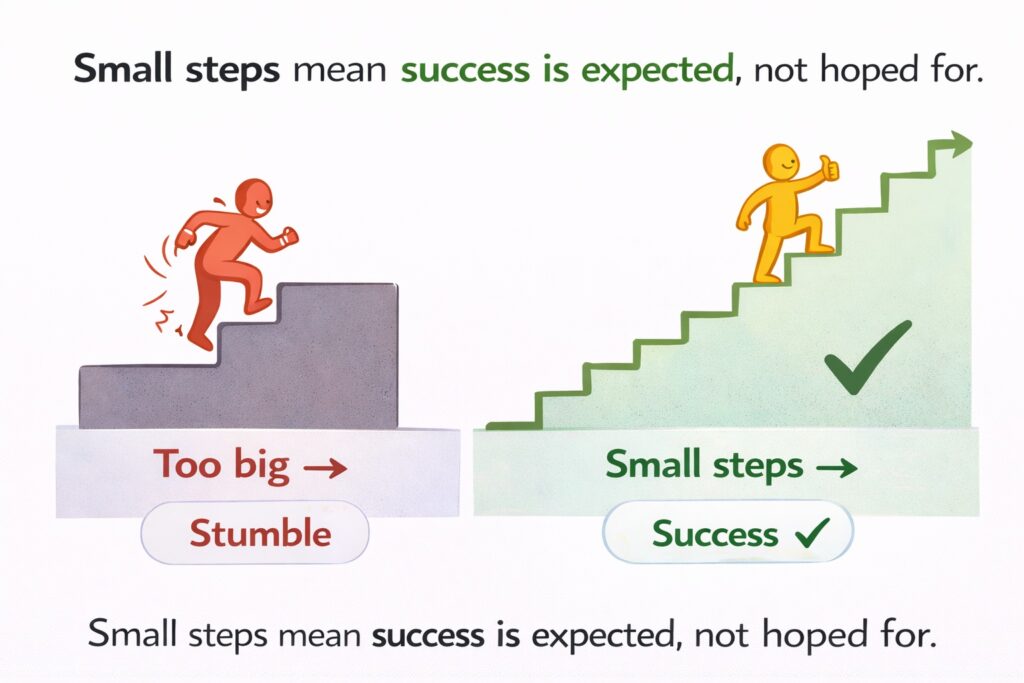
Progress is most reliable when each new step is small enough that success is expected, not hoped for. If a pupil stumbles repeatedly, the step was probably too large. Careful sequencing allows pupils to build knowledge cumulatively, and for pupils with dyscalculia or other mathematical learning difficulties, this structure is especially important. Gaps compound quickly in maths. Small steps prevent them from widening.
Consistent language and structure
The same vocabulary. The same models. The same routine. For pupils with SEN, consistency is not simply helpful, it is protective. When the structure of learning is predictable, pupils can focus on the maths itself rather than decoding a new system each time.
If the classroom lesson and the intervention session use different terminology and different representations, the pupil is effectively learning two systems at once. For many pupils with additional needs, that is an unnecessary and entirely avoidable barrier.
Success-first design
Pupils who have experienced repeated failure in maths need to rebuild confidence alongside knowledge. Practice should be designed so that getting it right is normal. This does not mean making the work easy. It means calibrating steps carefully so that pupils experience steady, visible progress. Success fuels motivation. Motivation fuels persistence. Persistence supports learning.
Baseline assessment: finding where the ground is solid
Before any of the other principles can work, there is a more fundamental question. It is critical to understand where a pupil is confident, where their knowledge is secure, and where we can build from with confidence.
This sounds straightforward, but in practice it is often skipped. A Year 5 pupil with additional needs is frequently given Year 5 support, because that is the year group they are in. But if their number knowledge has gaps at a much earlier stage, teaching Year 5 content on top of those gaps is like building on quicksand. The new learning will not hold, because the foundation beneath it is not solid.
Effective SEN/ASN maths provision starts with a genuine baseline. Not a general sense that a pupil is “working below age-related expectations”, but a precise identification of where their knowledge is secure and where it breaks down. Which number facts are automatic? Which steps in the progression have been genuinely understood and retained? Where is the last point at which the ground is firm?
Only from that point can teaching reliably move forward. A pupil might be in Year 5 but beginning their maths progression from a much earlier stage. That is not a failure. It is an accurate starting point. And an accurate starting point is the only reliable foundation for genuine progress.
This is why a clear, granular progression matters so much for SEN/ASN pupils. Without it, baseline assessment produces a vague picture. With it, teachers can identify the exact step where secure knowledge ends and targeted teaching should begin.
Readiness-based progression
Teaching from where the child actually is, rather than where the timetable says they should be, is more effective for pupils with additional needs. Age-related expectations are useful benchmarks, but progress is most secure when built on genuine readiness. Once the baseline is established, a clear sequence of small steps gives the teacher a precise route forward; not guesswork, but a defined path from where the pupil is to where they need to be.
Visual scaffolds for everyone
Manipulatives and representations support all pupils, and for those who struggle with abstraction or working memory, they are often essential. Consistent visual prompts and reference materials reduce the burden on working memory during independent work. Crucially, these scaffolds should be available to every pupil in the room. When support tools are universal, there is no stigma attached to using them.
Regular, low-stakes assessment
Waiting until the end of term to identify gaps is too late. Weekly insight into what a pupil has and has not secured allows teachers to respond within days rather than months. Small gaps caught early are far easier to address than entrenched misconceptions that have had time to deepen.
The challenge with patchwork provision
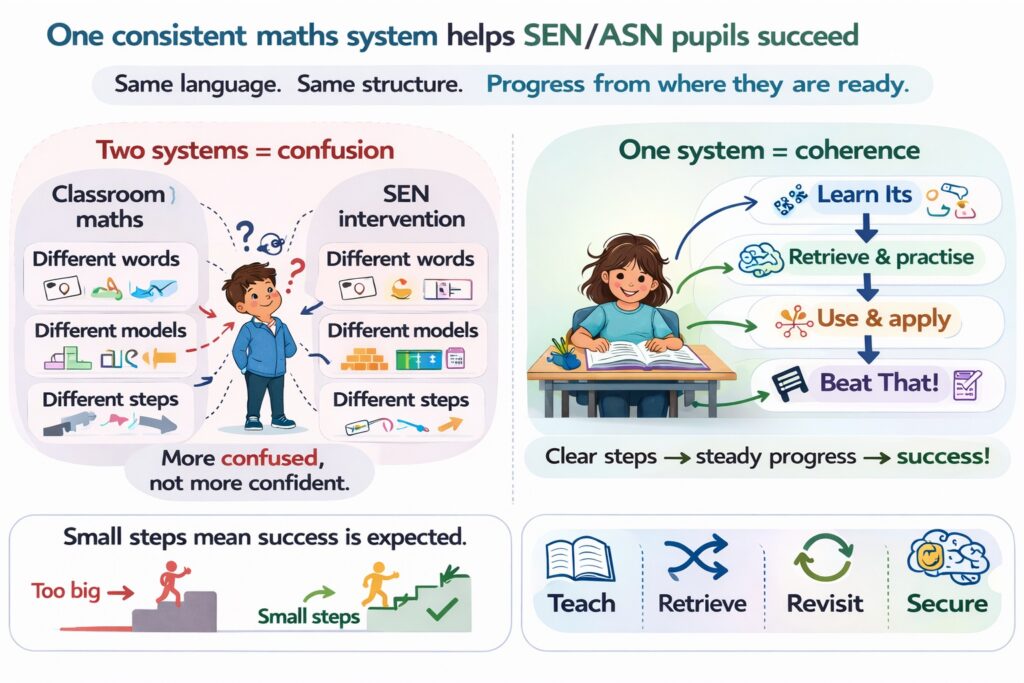
Many schools operate with a main maths programme and then bolt on a separate intervention for SEN pupils. The intervention uses different terminology, different resources, and a different sequence. The pupil moves between two competing systems.
For most pupils, this is confusing. For pupils with additional needs, it can be genuinely disabling.
The most effective provision uses the same framework as the whole-school approach. The difference is not the system, it is the starting point, and rate of progress within that system. A pupil working at an earlier stage of the progression is not in a separate programme. They are in the same programme, beginning from where they are ready.
What good provision looks like in practice
In a school where maths for pupils with additional needs is working well, the provision does not feel separate.
There is a consistent daily routine. A small, clearly defined set of facts or skills is being practised. Visual scaffolds are available to everyone. The teacher knows exactly which step each pupil has secured and which comes next. Weekly checks provide precise information, without pressure and without public ranking. Every child has something to celebrate each week.
The structure that supports SEN/ASN pupils is the same structure that supports every pupil. It is not a parallel system. It is a coherent one.
Closing thought
If your SEN/ASN pupils are receiving maths intervention that sits outside your main programme, it is worth asking a simple question. Are the two genuinely joined up? The same language. The same structure. The same sequence of steps.
Big Maths is designed so that SEN/ASN pupils use the same framework as every other child in the school, at whatever point on the progression they are ready for. The Progress Drives give teachers a precise map of every step in the learning journey, making it possible to identify exactly where a pupil’s secure knowledge ends and where teaching should begin. From that baseline, every subsequent step is small enough that progress is steady and success is expected. The same Learn Its progression. The same Beat That! challenges and celebrations. The same framework, beginning from wherever the ground is actually solid.
Find out how it works for SEN pupils → or book a free demo →